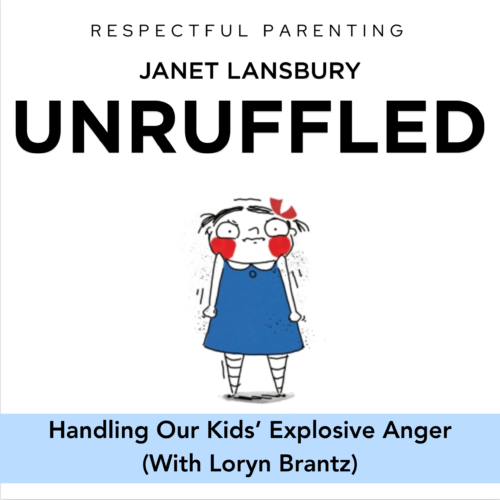
What do we do when our child erupts into a full-blown tantrum—suddenly becoming what author Loryn Brantz calls a “spicy nugget”? The award-winning author and illustrator returns to Unruffled to talk about her new children’s book, “I Am a Spicy Nugget.” Loryn and Janet unpack what actually happens in those moments—for the child, and for the adult trying not to make it worse—including what’s happening for kids when they become overwhelmed, and why the best response may be to do less, not more, and let the storm pass. Loryn’s book is inspired by her own experiences raising sometimes-spicy kids.
Transcript of “Handling Our Kids’ Explosive Anger (with Loryn Brantz)”
Hi, this is Janet Lansbury. Welcome to Unruffled.
Today I’m looking forward to speaking with a creative force. She’s an author, artist, poet, and director. It’s Loryn Brantz. Loryn has won Emmys for her outstanding achievement in designing and building puppets at Jim Henson’s workshop. She’s the creator of comics and numerous beloved children’s books, including the bestselling series Feminist Baby and It Had To Be You (A Love Poem Your Baby Can See). Our last conversation on Unruffled was about her book Poems of Parenting, which became a New York Times bestseller.
And her new book is my favorite of all because it’s about understanding and responding to our children’s overwhelming emotions. In I Am a Spicy Nugget, Loryn delivers a powerfully helpful and comforting message to parents and kids with her usual grace and humor.
Hi, Loryn.
Loryn Brantz: Hi.
Janet Lansbury: I’m in awe of your new book. I love all your books, but this one could probably be my favorite.
Loryn Brantz: That means so much, all of that coming from you. And I think you’re wonderful too. And you make me smile and I’m so happy to be talking to you again and back on your podcast.
Janet Lansbury: Thank you. Well, I want to talk all about your book and especially framing it around this incredible message that you were able to encapsulate and masterfully explain and demonstrate. I’ve spent hundreds of podcast episodes and blogs just trying to help parents do this because it’s the biggest challenge that we have as parents. And here you wrote a picture book and you totally nailed it. It’s really unfair!
Loryn Brantz: Thank you so much. That means everything, oh my goodness!
Janet Lansbury: This idea of allowing children to have their angry explosions, or this could be a tantrum or a meltdown. But anger is the hardest emotion of all, I believe, for us to accept. And I really want to know about your process, the process behind this book. How you got to this place where you’re able to do this with your children, and what goes on in your mind? What do you tell yourself? How do you bring yourself into that?
Because that’s what we need to know: How do we do this in the moment? How do we really get there? We can know that it’s the right thing even, but we’re still going to struggle when our child is expressing something strong and intense like that. So I really want to hear you share about that, because apparently you do have some experience with this, but you’ve just figured it out. How did you figure it out?
Loryn Brantz: It’s been such a journey. I really feel like me and my husband have been through the gauntlet of parenting. Everything’s just always been so extreme. So my daughter, she gets unregulated very easily and I wanted so badly to help her. And I read everything, tried everything, went to psychologists, specialists. I mean, one particular one gave us advice. The advice she gave us ended up being sort of a breaking point of us realizing that not all the advice we’re getting is going to work for our child and we really need to react to who she is and follow our instincts and tailor them to her.
She was having trouble staying in her bed at night. We had just had her brother, my son, and it triggered something they call “jack in the box syndrome,” where you put the kid in bed and then they just jump out all night. Meanwhile, we have a newborn crying all night. And it was painful. We weren’t sleeping at all, either of us. And it was so, so hard. And we talked to other people, learned so much more. I learned about PDA and all these things.
Janet Lansbury: Can you tell everyone what PDA is?
Loryn Brantz: PDA is pathological demand avoidance. And basically it’s when you ask your kid to put on their shoes, not only is there a normal power struggle of being a child, but their nervous system just short circuits because they feel a bunch of things. Maybe they feel like they’re not able to do it or they’re anxious about it.
And it’s sort of like realizing that anytime your kid is explosive or tantruming, kids don’t want to be like that. When they’re really little, it’s because either there’s some unmet need, like they’re tired or hungry—always, it feels that way. Or if they’re a little older, it’s because they aren’t capable of it. You have to meet them where they’re at.
And we started meeting Dalia where she was at more than I think most people meet their kids where they’re at. She really didn’t like washing her hands, it’s like a sensory thing. So we used hand wipes instead. We just found ways to tailor our lives to it. She just started developing so much better and faster and calmer, and she’s really doing amazing. And our son is doing wonderful too. I think we took that extreme version of what we learned with her and we put that towards my son as well, and it really works. What I mean by extreme is that her emotions are so extreme that we really had to learn how to handle that as parents. And then we took the version of that and brought that to the way we raised our son also. And it helps for both of them, even though they’re very different.
It’s just always knowing who they are and not judging them. I think people don’t realize how badly our children want to please us and they feel so ashamed when they think they’re not. And they don’t express that, they just freak out. Just knowing that the spiraling is coming from a place of them being embarrassed or ashamed, and that’s where that rage comes from, really changes the dynamic of how you deal with it.
Janet Lansbury: Yes. And it can come from other things too, just feeling the sense that they don’t control something or when they’re working so hard to find balance all the time with their extremely rapidly developing brain and body and everything else. It’s like they’re always off-balance. And then as you note, they have this immature self-regulation ability.
You said it perfectly in your email to me when you were describing the book. You wrote: “I really wrote this book as a reminder to parents, including myself, that your kid is not on equal footing with you. They are sweet little spicy nuggets with underdeveloped prefrontal cortexes that are still learning and growing. So before getting too mad, try to see them as clearly as you can and go from there.”
You say that “your child is not on equal footing with you.” It’s this perspective that is really the key to everything, and it’s what I want to talk about here. What you’re seeing there is going to make you feel a certain way. If you’re seeing an angry, intense adult, that maybe brings up someone in your life that is even abusive or whatever, then you’re going to react in a way that’s not going to help your child. Who isn’t anything like that, who is a tiny person that’s deserving of respect like other people, but very underdeveloped in certain ways. So we have to kind of train ourselves to see that and then see the unique sensitivities of each child.
Loryn Brantz: Yes. They’re completely new to planet earth. And it’s like they’re aliens coming to visit. They’re just new, everything’s new. And imagine how hard that must be, especially with their prefrontal cortex not being fully developed and unable to regulate their emotions. I mean, I see my kids with so much empathy and compassion because they’re like little sweet beings.
Janet Lansbury: Right. And they’re in the feelings. They’re always in the middle of the feelings. They’re not standing outside it, at all, ever. They’re not able to do that. They’re just in it and then they’re in the next one and then they’re out of it. There’s a lot of wonderful, inspiring things to learn from them. Like you said, the empathy and all that.
But the challenge for us is, when things aren’t going well, when they aren’t going easily, how do we remind ourselves to go there? So I’m just wondering, in that actual moment when your child’s becoming a spicy nugget—and that drawing that you made, that image of the nugget, I’m in love with that nugget—what goes through your mind? What do you actually do in the moment or feel or tell yourself?
Loryn Brantz: Yes. Well, what you said about being able to be outside of your feelings, I think is what you gain as an adult.That’s something you can do as an adult that they can’t do.
And something that happened alongside raising my daughter and learning to parent her was I was dealing with my own things. I have really severe OCD, I have anxiety, I have all sorts of stuff. So I started meditating a lot. With what was going on in my house, I needed to not be there for her in a way where I was just sort of containing myself like a soda bottle and then not letting it go. I needed to be able to find real inner peace to deal with all of this. Because I feel like she could tell if I’m not actually calm or letting everything go.
So I ended up meditating a lot and reading a gajillion books. The Untethered Soul, I’m obsessed with it, everyone should read it. That was my best parenting book, because I ended up learning how to become the observer of my thoughts and feelings rather than getting swept up in them.
Janet Lansbury: Who’s it by?
Loryn Brantz: It’s by Michael Singer. I guess it’s a self-help book about finding inner peace and radical acceptance. A theme of my life has been realizing what I can control and what I can’t. And as it turns out, I’m pretty sure I can’t control anything. And that includes my daughter’s feelings. I’m not there to control her feelings or change her, of course. I’m just there to make sure that she’s safe and loved as she learns and grows. And I know she’s this incredible person inside and just the sweetest, most loving little person. And that as she gets older, she becomes herself more and more. I’m just here to ride that wave with her.
I get very worked up over world news and all sorts of things that I can’t control. And so learning that, it gets so much bigger. It’s like, I can’t control what’s going on in the world. I can’t control how people feel about me. And I also can’t control my kid’s tantrums. It’s radical acceptance of that, basically. The good and the bad and everything is what it is.
Janet Lansbury: Can I ask what kind of meditation you do?
Loryn Brantz: Well, I did mantra meditation for a long time. Then I kind of just spend time quiet. I’m able to go there a lot, where I just sort of become the observer of my thoughts and feelings. And Gabby Bernstein has an app and she has meditations in it and I use them all the time. They’re great, they’re guided.
Janet Lansbury: I would go even further to say we don’t control our own reactions and reflexes and emotions that come up for us, triggers or whatever, in these situations. It sounds like you’re doing all this preventative work that’s really helpful, with the meditation and everything. And your partner, I guess, helps you have time to be able to do that, right? Because I meditate, but I didn’t start until I was an older person. And I think, gosh, would I have had time to do this when my kids were little? How would I have arranged that?
Loryn Brantz: It’s so important to me that I prioritize it. I do it just for 10 minutes in the morning, after the kids get to school because I don’t have time before. And sometimes if I wake up really early before they get up, I don’t get out of bed, but I’ll put on the meditation. And I do it right before I fall asleep—which, everyone goes to bed at some point. So those are the times I do it and it makes it easier.
Janet Lansbury: And then in the moment, if one of your children is going off, now you’ve had practice. And you’ve written a whole book! I wonder, did writing the book help ground you even more into this way of being around emotions?
Loryn Brantz: Yes. It certainly was fun to encapsulate what it feels like when that happens at my house. I particularly felt strongly about not having the adult intervene because something I’ve learned in my house is that intervention usually makes things worse. Doing less is more. So the grown-up doesn’t help the nugget calm down. She eventually calms down herself because they always do, and that’s when they unpack it and try again next time.
Janet Lansbury: Yes. So you recognize this now as a place that you’re safe to go with her, that you can let her be like this and that it will pass. Both of your kids, I don’t want to just say her. Do you feel like you are a volatile person like that?
Loryn Brantz: No, and neither is my husband. So we are both kind of like, Whoa. No, no, not really. I am very intense. I’m an intense and passionate person, I have strong opinions and this and that. But I don’t think I’m volatile though.
Janet Lansbury: Do you recognize when you’re even angry? Because I don’t until a bit later. And I feel like that is maybe partly my temperament, but also very much that this was totally unacceptable in my household. There were feelings that were fine to have, being sad and crying and all that, but not being angry or pushing up against my parent in any way. And I think I would’ve been a mellow person anyway, intense on the inside, kind of like you, but not somebody that explodes. But I don’t even recognize it. I’ll be crying or I’ll be just upset, and then later I realize, Oh, you were angry! And you have a right to be angry about that! But it’s unrecognizable to me.
Loryn Brantz: Yes. And there’s social conditioning too, with women about anger, and you just kind of end up bottling up so much.
Janet Lansbury: Yes. That’s why your book is so valuable and important. I mean, all your books, but especially this one. They’re all fun for parents to read to their kids, for one thing, but they also have a message for parents. And this one, I feel like if we could look at this every day when our children are young—if we have this intense type of child, not every child is like that—but if we have a child that’s intense and has strong reactions like that, then gosh, the grounding of this, it’s just magical. I feel like you’ve really hit on something so important. Just that reminder could be so, so helpful to parents.
You put it out there. I’ve said it in all these different ways, but I’m a person that talks about parenting and you’re a parent going through it and you’ve shared how it’s done, how you can do it. You both survive it. Your relationship gets only stronger through that. And it’s just this letting go that’s so hard. Like you said, you’re not getting in the way.
Because the thing is, when we try to say anything or do anything, we have to understand that that comes from a place of us being uncomfortable and wanting to make it stop. That’s why it doesn’t work, no matter what we say. Our child has actually gone to a whole different planet, that they don’t control. They don’t want to be there, they don’t know what happened or what’s going on for them. So how can we blame them, logically? And how can we find this place of peace with this?
Loryn Brantz: With my own OCD, I have intrusive thoughts that I can’t control. And it really made me relate more to my kids’ struggles because the impulse control and the explosiveness, I know it’s obviously not controlled. And I’m like, I get that. We know that deep down in our cores, we’re not that. We’re pure love on the inside and this stuff just comes up.
Janet Lansbury: I know I keep going to this, because I feel like this is the meat and what parents really, really need. So there you are, your child’s a spicy nugget, and you know that trying to do something doesn’t help. You know they just need to go there. But what is actually happening for you?
Loryn Brantz: It kind of depends on what the scenario is exactly. If we’re at home and let’s say she pushes her brother, she’s really mad, we’ll be like, “I think you need to cool off.” She kind of stomps around and screams and goes to her room. We just wait. And then I’ll go in there and we’ll have a hug.
Janet Lansbury: But that’s after, when she’s calmed down?
Loryn Brantz: After, yes. “I know you don’t want to hit your brother. We’ll try again next time.” And she does, and she’s gotten so much better with him. We had this really beautiful moment recently where that happened. Kids don’t want to be told to say sorry to each other, so I never really ask her to. But I’ll be like, “How would you feel if he hit you?” and this and that. And she had trouble verbalizing what she was feeling, but she took out her whiteboard and she drew a graph. They do this at school. There’s happy, calm, sad, and angry in the grid, and then she put a big dot under sad. And we were like, Oh, we know she doesn’t want to hurt anybody. She just loses control. And afterwards she shows her love even more. And then the incidents happen less and less. She just knows there’s nothing she can do that would make us not love and respect her.
Janet Lansbury: So you have a lot of practice seeing beyond what’s going on there in those moments and seeing your little girl.
Loryn Brantz: So there’s that version of things, where we wait. And also sometimes we really just have to pick her up and go. If we’re going to be late for an important appointment or something, there’s no other option but to pick her up and go. And I don’t make a scene about it. It’s just like, “Here we go, we’re going.”
The other thing that helps in our household, a huge thing is imaginative play and humor. If I can catch her or my son before an explosion with humor, it’s the best thing we can do. And we have a ton of strategies for leaving the house to make things more fun that work. I’ll open the door and pretend there are invisible animals running out the door and they have to race them. And I’m like, “Are you going to beat the cheetah? Here come the elephants. Go, go, go, let’s go. We’re going to race.” And they start running out the door. Doing conga lines to go to bed. If me and my husband start doing a conga line, the kids can’t resist joining in. That’s been really helpful. I mean, there are just so many.
And Spicy Nugget actually came from a moment like that. My daughter was getting a little worked up about something and I was like, “Are you becoming a spicy nugget? I’m going to dunk you in some cold milk to cool you off.” Which I don’t know, it doesn’t even make sense, but it was funny at the time. And I picked her up and started to gently dunk her on the couch, lift her up and down. And it really broke up the moment, we both thought it was really funny, and it lowered the temperature.
Janet Lansbury: Is it okay if I give a spoiler about the end of the book?
Loryn Brantz: Oh, yes.
Janet Lansbury: Okay. To me, this is everything actually that we need to know. So at the very end of the book, the little girl says, “Wait, what was I mad about again?” After she’s gone through this whole spicy thing and the way that you’ve shown the whole process of her getting to calming down. I think that’s what’s really important about this. Because we’re impatient as parents and we want it just to flow over and stop, but it almost has all these different levels in the book about I have to go there and then I had to go there and then I had to go there. And of course, for every child, it’s specific to them. But so often at the end, it’s so telling, they have no idea what happened or how they got there.
It’s such a brilliant reminder to us that they were not in their body, they were not in relationship with us there. They were off in their own place in that feeling. That’s just what happens. So how can we blame them for that? How can we punish them for that? It’s such a great reminder when they do that at the end. They have no idea, even if they didn’t say it.
Loryn Brantz: They just go back to playing with something.
Janet Lansbury: Yes. They just turn the corner. They’re la la la la la. And we’re kind of a mess, but we have to pick up the pieces. We can’t get enough reminders of this, as far as I’m concerned.
Loryn Brantz: Yes. And I think a lot of it is, I don’t know if this is the right way to say it, but don’t waste your energy during a tantrum. Don’t hurt yourself trying to help your kid. It’s not going to help them. And then you’re going to be so exhausted after that you won’t be able to play and have fun when they’ve totally moved on. Asking questions or trying to reason when they’re not hearing what you’re saying and they’re just totally dysregulated. So just go to your happy place in your head and know that they won’t be like that forever.
Janet Lansbury: Yes. And it’s not even that we have to play with them after or be in a good mood for them. This is just for us. Our own self-care means practicing as much as possible letting go of those feelings that other people have, especially our kids, who are just experiencing everything so vividly. And some people talk about riding the waves with them or whatever. Don’t ride the wave, sit on the beach. Or I like being the anchor, so I’m underwater. I’m just here. I’m not going anywhere, but I’m not trying to do anything to you. I’m letting your wave come and go and do its thing.
Again, I can’t recommend this book highly enough. It’s going to be so much fun for kids to read, so validating and comforting for kids to read, I believe, even if they’re not a person that blows up.
Loryn Brantz: Yes, that’s been the best part so far. A handful of kids I know have read it and they love it. They laugh so much when they’re reading it. They really enjoy it. They want to read it again. One of them now self-identifies as a spicy nugget. She’s my neighbor’s kid and she’s like, “This book is about me, right? You wrote this about me.” I’m like, “Yeah, sure!”
Janet Lansbury: Yes. Normalizing it, making kids feel, Oh, it’s okay to be every side of me. So many things in a short book. Well done. And I wish you all the success. You deserve it.
Loryn Brantz: Thank you so much. I’m so excited about your book.
Janet Lansbury: I am too. I think you’ll find that it took me a lot more words to say what you said easily, but all of this information’s in my book too, along with a lot of other things. Because my book is focused on babies, “Calming the Cries” is the relevant chapter. It’s about all the feelings and it’s about everything we’re talking about and how we can start getting in this groove early to make it easier for us. When our baby’s crying and we know that we’ve done everything to help them feel better and they’re still crying, how should we feel about this? How can we be there for them? Really supporting them, but letting go of that as a parent.
Because when we can get on this track early, it’s so much easier. I’m sure it’s easier for you every time your child becomes a spicy nugget because you’ve practiced, you’ve been to the other side, you know it’s going to end, like you’ve said. And that they were transported to this unreachable place, so you didn’t waste your time and energy trying to reach them there, but waited until they were done and then you’re totally there for them. But it’s a process and I feel we need a lot of practice. As long as I’ve been doing this, it’s still hard for me.
Loryn Brantz: It’s not easy.
Janet Lansbury: Anyway, thank you so much again, Loryn. We’ll be in touch again, I’m sure. And it’s great to have you back on Unruffled, sharing this great book.
Loryn Brantz: Thank you. Thanks for having me.
Janet Lansbury: Take care.
I Am a Spicy Nugget is going to be available September 8th, and you can get it wherever you get your books. We’ll also leave a link for you in the show notes.
Thanks so much for listening. We can do this.
♥
My new book is finally finished and available for pre-order. It’s called Baby Person. And I think you’re going to find it unlike any parenting book you’ve ever come across. For one, because this book is about us and the quality of our experience. It’s about how as parents or grandparents or anyone caring for children, you can discover a deeper level of fulfillment. You can have more ease, more joy, and more success day-to-day and in the long term. And at the same time, you’ll be building a lifelong bond with your child that’s steeped in trust, respect, and mutual delight. And if you pre-order now, I have an exclusive podcast thank you gift just for you. You can check it all out on my website, janetlansbury.com.