

My mom taught me that the worst thing you can be is a ‘phony.’ Like my mother, I value authenticity, and I hope my own children will always have the self-confidence to show their true selves to others and act the way they feel. I also hope that, as members of society, my kids have the kind of pleasant manners that make them desirable companions.
The infants and toddlers I spend time with in my parenting classes are just beginning to learn accepted social behavior and graces. In the meantime, I enjoy their unbridled authenticity.
Asa is an active, agile one-year-old. He almost never stops moving and has a wry sense of humor that is more evident each week. In a recent class we had the pleasure of a grandmother’s visit. Grandma Anne was attending for the first time. She sat with us as we observed her granddaughter and the other children interacting and thoroughly exploring the room. Suddenly, towards the end of the 90-minute class, Asa turned to Anne, extended his arm in the air and waved a big “Hi!” The spontaneous greeting took us all by surprise, since Asa had been focused solely on activity until that moment and had not acknowledged Anne’s presence earlier.
A few minutes later, the parents and I compared the value of Asa’s exuberant salute to the more dutiful greeting a child might give in response to a parent’s prompting. We all agreed that Asa’s honest gesture was preferable to a thousand adult-initiated toddler ‘hellos.’
I understand a parent’s wish to raise a child with good manners, and we all want our children to know the basics: “Hi,” “Bye” and “Thank you.” Our children’s public behaviors feel like a giant reflection on us, both as people and as parents. When someone greets our baby, we worry that the person might feel rebuffed if the baby does not respond in kind. Even though this fear is usually unfounded, most of us believe our child’s social emotional development is more important than the possible ruffled feathers of others. How do we best teach children to be polite and caring, while also encouraging their authentic responses?
The answer is to trust and model.
Trusting the child means appreciating his or her simple, honest reaction to a situation, rather than wishing for more. It is common for parents entering my class to say to their baby, “Say ‘Hi’ to Janet, or “Say, ‘Bye-bye’!” when the class is over. More often than not, the baby is looking me in the eye and telling me those things in his own age appropriate way. The look of acknowledgement communicated through a child’s eyes is infinitely more valuable to me than a parent waving a child’s hand, or telling the child to wave his hand. When a baby does have the impulse to wave on his own, or when an older baby spontaneously says “Hi” or “Bye” to me, it’s icing on the cake.
A child imitates the adults in his life, so parents teach best by modeling the manners they want the child to learn, then trusting the child to incorporate those responses into his social repertoire when he is ready. When a baby first waves, he will often wave towards himself, since that is what he sees. This backwards wave represents a brief moment of time in a baby’s life, before he learns the ‘right’ way. Now that my children are older I truly appreciate the charm of a baby’s early efforts to socialize through imitation.
In our attempts to be good models for our children, we may find ourselves using the words ‘please’ and ‘thank you’ a bit more often. Wait, who’s teaching whom manners here?
It’s especially valuable to model “Thank you,” instead of the commonly used, “Good job,” when a child is cooperative or helpful. “Good job” is a reflexive response for parents, but it is the kind of praise that feels more like an authoritative (and slightly demeaning) stamp-of-approval than a response of appreciation. We help our child to grow authentically when we describe an accomplishment rather than praise it. “You put your foot through the pant leg yourself. Thank you for helping to put on your clothes.” A gracious acknowledgement helps to keep a child in touch with the intrinsic reward of his accomplishments, rather than training him to perform for praise and approval. (When our arms are full of groceries and someone holds the door for us, we don’t say ‘good job.’)
Even when we have modeled graciousness for a child, we must still find the patience to wait for him to find his own motivation to show gratitude. If we force him to mimic good manners, the child may begin to perform for approval only and not as an expression of his genuine feelings. Ultimately, we want our children to understand the words and greetings they are using. Realistically, most children cannot be expected to say “Thank you” (and mean it) until they are at least 4 or 5 years old.
I can relate to a parent’s impatience to hear a child express gratitude. I still worry that my eight-year-old son will forget those words and I occasionally ask him quietly, “What do you say?” or remind him, “Don’t forget to say, thank you.” But if I waited another moment or two, my son might say those words on his own without prodding. When I am on the other end of this scenario, as the host or helpful person, I know I would much prefer a child to look in my eyes, smile shyly, or do nothing at all, than perform a robotic “Thank you, Mrs. Lansbury.”
Our trust and patience are an investment in a lifetime of good manners motivated from within. Instead of prompting responses from our baby, we should try to relax, observe and enjoy our child’s natural reactions and expressions. We might be surprised by our child’s spontaneous displays of cheer and affection. And when we encourage the authentic development of social skills, we give our child permission to continually act from the heart.
When one-year-old Max entered the classroom during a recent parent/infant class, his friend, Jack, walked over and gently embraced him. I can’t imagine a more sincere “Hello.”
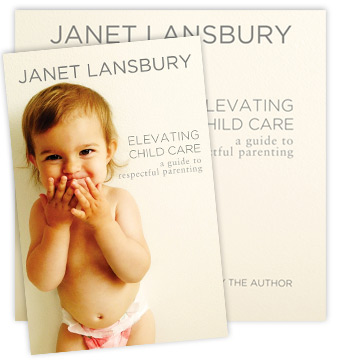
I share more practices that help raise children with respect and authenticity in Elevating Child Care: A Guide to Respectful Parenting (now available in Spanish and Chinese!)





i was just talking about this very thing to a friend today. i am making a new dance and am interested in the ways that it seems so important to other moms that their babies are waving hi and bye. jace is not doing that yet and it just seems like this horribly fake thing that i seem both compelled to “get” him to do while also really not caring one way or another. in my rehearsal today i was thinking about this – how many movements and behaviors are put upon us, which ones are for us, which are for others.
thanks!
Hi there, Janet!
I am a fan of Magda Gerber and have read both of her books. I am so glad to have found you on the web.
Anyway, a mom friend told me about the “Your Baby Can Read” program and I was just wondering what you thought about it? It seems kind of sketchy to me…but at the same, I think, “Well, if I could teach my baby to read…wouldn’t that be something that would be good for her?” My daughter is 1 year old.
Your candid thoughts and opinions would be appreciated.
Best,
Tina
Hi Tina,
I’m looking forward to sharing my thoughts with you regarding early reading instruction for babies and toddlers. Since I have a lot to say, I’ve decided to write a new post on the subject. With any luck, it will be finished and ready to go by this Sunday evening!
Thank you for inspiring me with your question!
Warm regards,
Janet
Here’s the post on “Your Baby Can Read” : https://www.janetlansbury.com/2009/11/your-baby-can-read-costs-too-much/
Oh, and one more thing…what do you think about teaching babies/toddlers sign language?
Thanks again!
I think teaching sign language can only be a positive, but I don’t believe it’s necessary. What’s important is to communicate with babies from the beginning and open the door for them to answer in return. Infants begin to respond to this very quickly…by lifting their arms to us when we ask, “Do you want me to pick you up?” And by preparing their muscles when we say, “Okay, I’m going to pick you up.”
Infants and toddlers will develop their own signs and signals for things…
One of the aspects I love about Magda Gerber and the RIE Educaring Approach is that it is about trusing infants to be self-learners. That means they learn language organically through our interactions with them. We don’t have to give them “lessons”, or do anything to teach them that doesn’t feel natural to us.
But if a parent enjoys teaching a baby sign language while they are interacting, wonderful!
My sister juts had a new baby 20 days ago. She is a single mom by choice. Her 5 year old son has, understandably, been struggling since the arrival of the new baby. He is demonstrating challenging behaviors, which makes sense to me given the new situation. Tonight at my mom’s house he was vehemently resisting requests to get ready for bed and brush his teeth (we are all sleeping over) Once he was finally ready after I offered help and companionship to accomplish those, he just plain refused to say goodnight to my dad, who told him in a stern tone “look at me and say goodnight, otherwise I won’t want you to come spend the night at our house anymore”. I found that SO incredibly out of line. Demanding respect and politeness when you are threatening can’t be right! It felt so wrong. It broke my heart ;( I went up to my nephew, got down at his eye level and said “goodnight, I can see you are tired and you don’t feel like saying good night right now. I understand, that’s ok. I love you” he gave me a smile and went off to bed.
<3
Janet: reading and sign language to a toddler? I am in bizarre o land or maybe just not good at being a mother. My one and a half year old and i should be reading? That is a new one. I was given your site by a friend of my sister because she thinks I am too nervous about parenting right. Maybe I am but it’s my only child. I think it is Ok to be nervous. I read a lot on the web when I have time and get good ideas. But I have never heard of a child that old reading. This is eye opening to me. are there RIE classes everywhere? Where can I find classes? Thank you
Don’t worry! You definitely do not need to teach your baby reading or sign language and your parenting instincts sound wonderful. I am just now finishing up a post about the “Your Baby Can Read” program, and it isn’t a recommendation!
I wish there were RIE Parent/Infant Classes all over the world, and some day there will be, but for now please check the web site ( http//:www.rie.org , or my community section.) You will see a list of states where we have teachers and classes available. For more information, I also recommend Magda Gerber’s books, Dear Parent and Your Self-Confident Baby, and other books listed on my site.
Thank you so much for reading my blog!
Hi Janet, I wish there were RIE parent/infant classes all over the world, too. I’m doing my RIE III on how to start a class outside of LA. I’ve interviewed some of the women who are trying it. I wonder what would be most helpful so that more teachers can take up the work in other places around the world and be truly successful.
Hi Kim,
Polly Elam and others travel around the world doing RIE I trainings, but it would be great to have more RIE Associates doing this. One of the reasons I began this blog was so that RIE could have additional ways to educate. And I’ve been encouraging other RIE Associates to write too!
Your project sounds like a helpful one!
– Janet
Just like to say that one thing that would make it easier for more people to become RIE certified is the cost, it is so expensive especially when you have to include flights and accommodation on top… i know it is an investment but for a low-income student it is just an unrealistic dream…
Letisha, I agree. Hopefully there will be online options for training soon!
I totally agree. I have twice had to bypass RIE training in London because it’s so expensive. And I know many mothers who are very eager to hire RIE nannies (myself included) but can’t find any here. I’ve been looking for 4 years!!!! We have no toddler groups in central London and RIE or Pikler nannies are so hard to come by. And the training so expensive. It’s a blessing we’ve got Janet online 🙂
Hi Janet,
You directed me to RIE when you were staying in Topanga. I lived in the home below your sister-in-laws and you saw me with my then 6 month old and asked me if I knew about it. I had not, but soon was with Harrie in Santa Monica for classes. I now have three children in which I raised with RIE practices and sent them all to Linda Hinrichs at Children’s Corner. The interaction with you that day and the information you passed on to me as a new mother was priceless. Thank you so, so very much. I had no idea!!! Recently reconnected through Facebook with you via another Topangan. I hadn’t a clue that you were so active with RIE. Wonderful job. My children are now in a Waldorf inspired public school close by.
I do have a question in regards to the posting here. My middle child Hope is now 7 and still is horribly shy when she is asked to apologize for hurting someone. Most of the time it is because she is clumsy and an accident happens, but sometimes she’s testing things out and plays a little too rough(older and younger brother to contend with) and can leave friends in tears. Not sure what this behavior means, but somewhere in the back of my mind(also having four older brothers) I can remember “accidently” hurting someone. I was also painfully shy and clumsy too. Now I have grown to be a genuinely kind person, very open and friendly and loved for my compassion. I am obviously fine, yet I not only worry what other’s think when my daughter is unable to apologize for causing their child to cry but at a loss for words when she crawls into her shy cocoon, wrapping her self around me to hide from embarrassment. Most of the time I will acknowledge that the other child is hurt. For instance today, I saw Hope drop her foot down on a younger boy’s ankle while sitting next to each other laughing on the grass. The boy’s mother addressed my daughter, also a RIE parent. I let them finish, the boy still crying, the mom scooped up her son and walked away. I asked my daughter if she was able to apologize and she started crying and clenching my shoes. I bent down and said, “Hope a simple I’m sorry makes people feel better, especially yourself. I’m going to let you calm down and when you are ready you can talk to Taj the way you want to.”
I went to the little boy and his mom said he just had stitches removed where he got kicked. I said to him, “Ouch, I’m sorry that Hope dropped her shoe on your scar. I can understand that is a super sensitive spot. ” Meanwhile he is showing me the spot and I say that “I see it”. My daughter dries her tears and walks over to him and finally says her honest, quiet and beautiful “I’m sorry”. And of course all is taken care of. This was a wonderful moment, YET, I usually have my hands full and it doesn’t always happen this way.
I guess my question is… does it work to apologize for your kid. I know that it feels right when I’m doing it and obviously my girl stepped up and did her apology after, so does this model work?
Thanks again!!!!
Hi Jennifer!
It was such a great surprise to hear from you. I remember you well from our 6 month stay in Topanga. The very first day we stayed at Ally and David’s house their dogs escaped, I was in a total panic and you rescued them, didn’t you? Thank you again! I am so glad to hear that the RIE philosophy has helped you, and I’m thrilled that you found Linda’s amazingly wonderful pre-school!
Thank you for your question about your daughter’s apologies. You’ve actually given me ideas for not just one, but two posts in response. I’m now plotting a short article about saying, “Sorry,” and another one on shyness. My immediate thought is that when you stopped worrying about your daughter’s response and modelled your own sincere apology, it freed her up to do the same. It is difficult for children to be sincere when they feel “on the spot.” Yes, I think modeling is the best way to go.
Thank you again for your message. I’m so happy to hear from you about your successes as a caring mom. And please tune back in for my longer answer about children and apologies.
Here’s the apology post: https://www.janetlansbury.com/2009/12/youll-be-sorry/
Hi Janet,
I loved this post, especially since it reflected so well on my boy. He is nearly 2 and does not perform upon request. The nice thing is that when I am in a situation where I say please, thank you and excuse me, he will usually echo that.
I enjoyed reading this too. In my group at day care we have a one young girl who seems to have nominated herself as the unofficial greeter in the room. When anyone enters she lifts her arm (elbow straight) and waves, calling “hellooo”, and when they leave she waves again, this time saying “bye, addaday” (“have a good day”). Each time she does it it makes me smile. I love how balanced your answer to Jennifer was, and also how sensitive Jennifer was to her own child’s feelings. I’m now heading off to read your apology post.
Yes, aren’t those spontaneous greetings the best?! Thanks for your kind words.:)
Thank you, i was gonna write a post about a similar topic, but you’ve done a wonderful job already on it (good job! ;))
Our little man has explored the good bye thing and as soon as i enter the creche to pick him up he waves to the garden, the children and the teachers calling “bye-bye” like a million times. It’s so sweet and we never taught him to do it. But he also waves at a leaving subway or at me when i want to hug him and he doesn’t want me to. I love how he is finding his own way through the jungle of social behaviour and you are right that this is so much better than a forced “good morning!” it’s like a laughing baby that laughs on his own compared to one that is tickled to laugh…
“I love how he is finding his own way through the jungle of social behaviour…” Yes, it is a jungle out there, isn’t it? 🙂 I love the “waving to the garden”! Thanks, Nadine. I do hope you’ll write on this topic, too.
Janet, reading your blog brings tears to my eyes. You say so beautifully and gently what my Mom believed passionately.
Bence, thank you, it means the world to me to hear that. I am working hard to channel your Mama as best I can!
What’s funny is that my 11-month-old waves enthusiastically at our cat and dog every time she sees them. She will wave to people she knows but is hesitant and often waves after we leave. Strangers? The ones who kindly say, “Aren’t you adorable?! Do you know how to wave yet? Hello! Hello!” She just stares at them, which is really pretty good instinct, I think. A wave is an expression of affection to her, and she so far seems to be a reserved kid. This post served as a good reminder to not ask her to perform in that way. Rather, I think I’ll focus on modeling greeting and affection with friends – not in a phony way – but in a focused way, rather than putting the focus on her interactions. I love your comparison of “good job” and “thank you.” Makes perfect sense.
Yes, an expression of affection! And what a gift to an 11-month-old to not have to perform. Just being herself is good enough. Thanks, Alice!
Important article. Whenever my grandchildren handed me something (like a spoon) they were exploring, I always said thank you, and then I gave it back to them–since I actually think I know Spoon by heart. All four of them over the age of 4 say thank you just like they say “Hi,” and I only rarely remind them to say “Thank you.” The two that are under two aren’t talking, yet.
Kids are designed to sponge up and copy the way the world really is.
Caveat: to really learn X, humans have to try out NOT X. Don’t get mad, just go back to “No, driving on the left hand side of the road is not done in America–it’s too dangerous.”
Janet, it’s so nice to see this reposted, as we have just recently seen the benefits of this approach. A couple of weeks ago Maria (21 months) had woken up from her nap and she did a slight gesture indicating that she wanted me to take her socks off. I pulled them off for her and she looked right at me and said “Thank you.” !!! You could have knocked me over with a feather.
She has done it several times since . . . like yesterday we were in the car on the way to the grocery store and her dad indicated that we needed milk, and I said (to Maria) that yes, we needed to buy some milk for her bottles. Maria: “Thank you.” . . . Well, really “sank you,” but that’s even cuter. 🙂
The challenge will be not to push the thank-yous once she’s more routinely in a position where she “should” be thanking others besides us (teachers, relatives etc.). Still, I hope said others will appreciate, as we are now, how wonderfully rewarding the authentic and unprompted ones are!
This is a great post, and it is so true, we expect our kids to be socially gracious… and it is phony! Yet at the same time, they do need to learn to be gracious socially to do well in life. It’s a tough one. How often as adult, do we not really want to be gracious, but we need to be? That’s life… our kids do need to learn the same. So while I do agree with this, I think there is a time and place to learn this. For instance, you may not really love what Grandma got you for Christmas, but it’s not always about what you want… It’s a gift from Grandma’s heart…so be thankful for how much Grandma loves you. But I don’t think that’s something you teach your toddler! That happens over time.
As for the sign language…both of my sons have had/do have expressive communication delays due to oral motor challenges. They have pretty typical cognition and receptive skills, and I think giving them ways to communicate is vital to help with frustration. There are lots of ways to do this. One is showing them ways to gesture, giving them pictures, whatever works for a particular child. My toddler turned 2 recently. He uses his own “signs” and “gestures” to get his point across nicely. I think your typical toddler would pick up sounds and repeat words, but those with oral motor challenges may need some input and help in that area. Again, modeling those things is the key.
Thanks Janet for another great article! : )
I read lots of your post and love them. Your advice, encouragement, and information is always so relevant and helpful. Thank you for all you do.
We are currently trying to help our just-turned-three year old work on saying “please” when making requests. He is highly verbal and has been speaking in paragraphs since before he was two, so sentence structure isn’t an issue or anything like that. Anyway, I do think it’s important for him to learn to say “please” when asking for things, but it just feels off to constantly be saying, “How do you ask nicely?” or “What word should you add to make that a polite question?” I mean, he knows the answer is please, but I feel like he’s going to start saying it by rote. On the other hand, his typical way of asking is blunt, “More corn!” “I need milk!” etc. I do think we model “please” well (though I’m sure we could always do better). Any ideas? Thanks.
perhaps not actually asking him or quizzing him to say the word, but just gently repeat back the question. E.g “more Milk” and you reply “More Milk please? here you go” And always make sure that when you are asking him for things you add on please and thank you – Please sit down, thank you for that block, can i have your sock please, please pass me your spoon, thank you for your spoon… you probably are already doing that 🙂
My friend was telling me last night that her daughter for the first time strung together multiple words – and guess what she said?
She turned to her mum, smiled as sweet as pie and said “Ank- youu Mum” (thank you mum). She has never been forced or prompted to say thank you and please, only modelled by everyone around her. My friend was almost in tears telling me – “I don’t ever need to be told thank you again, there was so much gratitude in that”
I have taken a ‘mid-way’ approach to the basic manners of ‘Hi, Bye and Thank-you’. And ‘Please’ as well for that matter.
I have explained them to be markers, reference points, symbols in the social interaction.
For instance Hi denotes that you are entering a situation, Bye that you are now leaving that situation (and particularly if that is daycare, a member of staff meeds to know that the child has transferred to their care or left their care)
We refer to Please as ‘the asking word’ (I dislike ‘the magic word’ intensely – how does that work if the request is refused?) and Thank you to acknowledge receipt “Yes, I have noticed that the drink has appeared on the table” (So I am hopefully less likely to knock it over!)
I do not force any of these words, but if the child won’t say them then I calmly say them myself – if I feel they are necessary then it shouldn’t be a big issue that I say them!
My boys have usually followed my cue though not always, or even often, in the same style. My 5 year old’s favourite for quite a while was to growl like a scary monkey –
“Oh look, there’s ‘preschool teacher’, she should go and say Hi so that she knows you have arrived. Hi ‘preschool teacher'” Teacher “Hi, Helen, Hi Joe” Joe “I’m a scary monkey, Grrrrr!”
Oh well, at least she definitely knew he’d arrived!
I was just telling myself I need to work on this very thing. I’ve become a lot better about not forcing Sisi to say scripted lines to strangers, or when she’s feeling overwhelmed, but I still find myself forcing her to say “sorry” to the dogs for pulling their tail, or say “good night” to daddy, etc. It seemed harmless, but I am really going to try to let her responses be genuine, and trust that modeling manners will teach her what she needs to know. Thanks for this extra inspiration!
Hi Janet, We are having a manners problem with our 3 year old boy. He has always been very social, he used to walk into school and wave hello to all the teachers in the courtyard. Recently, maybe the last 3 months, he refuses to say hello and if anyone approaches him, he will either put up his hand and say NO rather rudely or he will ignore them all together. He also suddenly wants to walk in alone. For example, if another family is entering the school he, refuses to walk in at the same time. Otherwise, he is increasingly anti-social at the playground with friends (kids he’s known for his lifetime) and it takes a long time for him to warm up to some adults in social situations. I have to say he is an otherwise, pleasant (albeit challenging since he is a toddler) little boy. He is bright, loving and clever. My husband and I feel a little overwhelmed by the anti-social behavior since we parent respectfully (most of the time, we are human) and we do model proper social behavior consistently. I know we will need to trust that he will come back around but the impression he is making is embarrasing at best and worrisome at worst. Thanks for any feedback you can offer.
Yes, modeling is best. We must also ask ourselves why we demand of children what we do not expect of ourselves or other adults. For instance, I often leave a friend’s house and say goodbye but do not feel compelled to issue a formal, “Thank you.” Nor would I say to my husband in front of others, “Say thank you.” When I was teaching, parents often told their children to say good morning or hello to me and then prodded them when they didn’t. I would say, “He smiled at me and that’s the nicest greeting of all.” And lastly, if a child is about 5 yrs. or older and you notice that he/she is still not saying thank you when it is appropriate, then you can talk to them at home (never in front of others!) and explain that using phrases like that makes people feel good and tells them you appreciate them. Just explain it truthfully. It’s not a moral issue. It’s simply a kindness. Frankly, I do not appreciate phony “manners” from adults or children.
Dear Janet,
My DD is 4 and her antisocial behavior has come between my best friend and I. This weekend I was told by her that I was a bad parent because I don’t make my daughter say goodbye. The problem is, I can’t make her, it only gets worse. We’ve finally got to the point that if DD can’t use her voice then she can wave and she does that, so that’s a win but it took half a year. It’s not what the adults want, but for whatever reason, it’s all she can do. It’s horribly embarrassing for me. It takes everything in me to not press her and to respect her but manners and social graces are very important and I think she’s too old to behave this way. And now, it appears to people that I don’t teach my children manners! (Ironically, 2 years ago same friend accused me of teaching DD to be too “fancy” and polite!) I’m just a complete loss. She hurts my friends and family’s feelings when she withholds the basic hellos and goodbyes and that in turns hurts me. Other than this, she is a kind, loving, inclusive child. Janet, I have followed you for almost 3 years now and I am so happy that you have helped me become the parent I am. We have a loving, calm (most of the time) and happy household and that is thanks to you and I am forever grateful.
Hi Janet,
My 2.5 year old is highly exuberant, verbal, and inquisitive. She has recently and increasingly become “demanding”.
I’ve become self-conscious of her lack of manners…Please and Thank You. My husband and his parents feel that she must say please to preface requests…and I feel that this expectation is unrealistic.
When we ask her to say please, she recites “Please mama/dada/etc I want______please”
It appears as though her impulse and desire to have something prevents her from implementing the polite way to ask for something.
Do you have any thoughts on a middle ground for how to approach this?…She we drop pushing her to say “please” and let her do it on her own? I’m struggling on creating some boundaries on this. THANK YOU!
I dunno, my 16 month old says “thank you” (well, “deet doo”) spontaneously at appropriate times. I’ll accept that he may mean something more like “yay, I got it!”, but it’s really quite similar to when you might expect it from an older kid. And since grandma taught him sign language for “please” he’s been doing that too lately. 4 or 5? Really???
Hi Janet. I tried very hard to do this with my kids when they were young, hoping that my introverted daughter would slowly develop the social awareness to greet people, but at 6 years old she still prefers to avoid eye contact and at best mumble a hello. I do respect her introverted nature, knowing that I myself often would prefer to avoid forced social situations. Do you have any suggestions for a kid a bit older?
I wonder about this too. It’s so hard not to make it about me. My 4 year old just got a gift today, didn’t say thank you (expected), but I really value gratitude and gave that little push “Can you say thanks for the present?”) even though I know it’s recommended against! It backfired of course and she said “I don’t want to.” And of course then I felt embarrassed and like I’m raising a rude kid. I know that’s all part of the trust Janet writes about, but i think how cute it is when you see a kid with good manners, and I guess I just wish my kids were viewed like that. All vanity on my part.
Another thing is I value writing thank you cards. I’ve always done it, even as a kid, and I want my my kids to do it to. Of course they won’t, although they will sign or draw a picture for it, and I wonder if they will have it as a habit as adults or older kids. Is it ever ok to push??